
Beyond the Hype: A Value Engineering Approach to AI in Talent Management
The race to implement Artificial Intelligence in HR is on. With 76% of companies planning to adopt AI in their talent functions within the next 18 months, the pressure to modernize is immense. But in the rush to automate, most organizations are falling into a critical trap: they are optimizing for speed and cost, while unknowingly destroying the very human elements that attract and retain top talent.
If you use AI to speed up a broken process, you don’t get innovation. You get a broken process, faster. You scale bad experiences at an algorithmic pace.
This is the efficiency trap. The good news? There’s a better way. It’s called Value Engineering—a strategic approach that ensures AI serves your talent ecosystem, not just your bottom line.
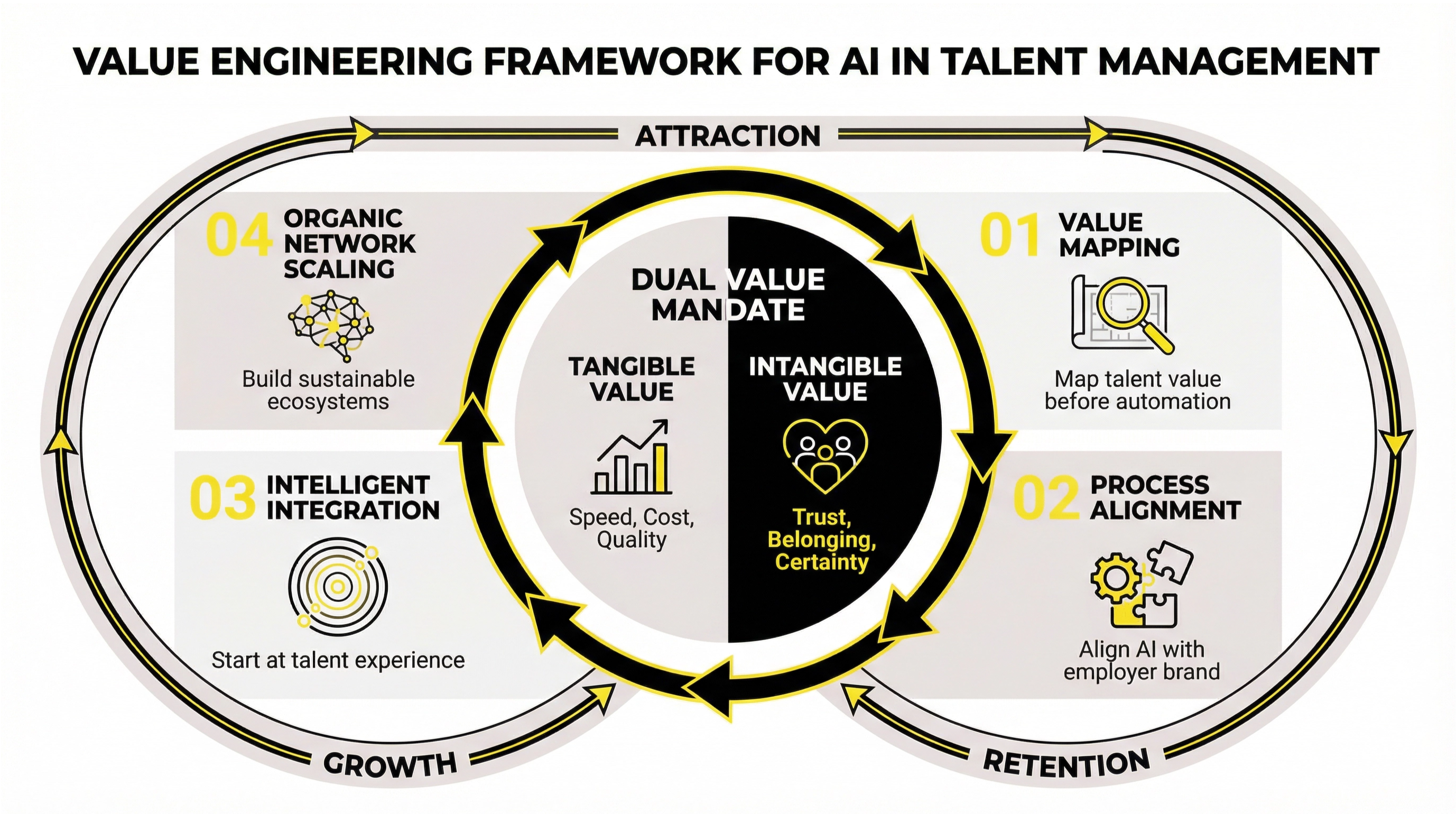
The Dual Value Mandate: Engineering Value, Not Just Efficiency
Before any AI tool is deployed, it must be measured against the Dual Value Mandate. This framework forces a simple but profound question: how does this technology improve both tangible delivery and intangible experience?
• Tangible Value: The measurable outcomes. Think speed, cost-savings, and quality-of-hire.
• Intangible Value: The emotional impact. This is the trust, belonging, and confidence your talent feels.
Efficiency without empathy is destruction. Here’s how the Dual Value Mandate applies across the talent lifecycle:
Lifecycle Stage | Tangible AI Wins (The "What") | Intangible AI Wins (The "How it Feels") |
Talent Attraction | Speed & Efficiency: AI saves recruiters 20% of their weekly time by screening thousands of resumes instantly. | Trust & Confidence: Transparent AI use and the elimination of “ghosting” (currently experienced by 48% of candidates) builds confidence. |
Talent Retention | Predictive Analytics: AI identifies flight-risk patterns from historical data, enabling proactive intervention before an employee resigns. | Certainty & Growth: AI-powered career pathing reduces anxiety and addresses the 71% of employees who leave for lack of development. |
The 4-Stage Playbook for Value-Engineered AI in Talent
To move beyond the hype and start engineering real value, you need a disciplined framework. This 4-stage playbook provides a roadmap for a successful and sustainable AI integration.
Stage 1: Value Mapping
Principle: Map your talent value before you automate.
Before touching any process, identify where trust, differentiation, and competitive advantage are created in your talent ecosystem. If you cannot articulate the intangible, emotional value of a touchpoint, you are not ready to automate it.
Stage 2: Process Alignment
Principle: Align AI with your employer brand.
Every AI implementation must pass a simple test: does this amplify what makes us a great place to work, or does it fragment it for the sake of efficiency? If your brand is built on a personalized candidate experience, your AI must enhance that personalization, not replace it with robotic interactions.
Stage 3: Intelligent Integration
Principle: Start at the talent experience and work inward.
Automation should not begin with internal efficiency metrics. It must start with the candidate and employee experience. Use AI to handle the workflows (screening, scheduling) so your human teams can handle what matters most: connection, conversation, and judgment.
Stage 4: Organic Network Scaling
Principle: Build sustainable talent ecosystems, not fragile pipelines.
The ultimate goal is a circular system where attraction, retention, and growth feed each other. Use AI to connect the data flows. Let your retention insights refine your attraction algorithms, and let your candidate experience data inform your onboarding process. This is how you achieve sustainable scale.
The Future of Talent is Human-Centric, AI-Powered
The companies that win the war for talent won't be the ones with the fastest AI. They will be the ones who use AI to become the most human.
By adopting a value-engineering mindset, you can move beyond the efficiency trap and build a talent strategy that is both technologically advanced and deeply human. You can use automation to buy back the time for connection, turning AI from a potential threat into your greatest asset for building a world-class talent ecosystem.